Les meilleures box par abonnement ne sont pas forcément les plus grandes, les plus chères ou les plus richement décorées. Pour les marques, la box idéale est celle qui protège le produit, sublime l'expérience de déballage, maîtrise les frais de port et donne aux clients l'impression d'un colis conçu spécialement pour eux. Pour les marques de bijoux par abonnement en particulier, un coffret rigide ou un écrin à bijoux personnalisé et bien conçu peut faire toute la différence, car l'emballage devient partie intégrante de l'expérience produit. Le choix de la meilleure option dépend du produit, de la clientèle cible, du mode de livraison, du volume des commandes et du niveau de présentation souhaité par la marque.
Les box par abonnement sont devenues un moyen pratique pour les marques de fidéliser leur clientèle. Au lieu de convaincre un client d'acheter à nouveau tous les quelques mois, un abonnement crée une habitude : celle d'ouvrir sa boîte, de recevoir un colis et de découvrir une nouveauté.
Mais il y a un aspect du secteur de l'abonnement qui est souvent sous-estimé : la box elle-même.
Une box par abonnement ne se contente pas d'être esthétique sur une photo. Elle peut être stockée en entrepôt, manipulée par plusieurs transporteurs, chargée dans un véhicule de livraison, ouverte par un client, photographiée pour les réseaux sociaux, puis réutilisée ou jetée. Par conséquent, les choix en matière d'emballage ont un impact à la fois sur l'expérience client et sur les coûts d'exploitation de la marque.
Il n'existe pas de formule d'abonnement unique qui convienne à tous les secteurs. Une bonne box par abonnement repose généralement sur un équilibre entre cinq facteurs : la protection du produit, l'apparence, l'efficacité de la livraison, la personnalisation et le prix.
Par exemple, un abonnement à des soins de la peau se prêtera parfaitement à un emballage léger, comme une boîte pliante ou une boîte d'expédition. Un abonnement à du café nécessitera une structure en carton ondulé plus robuste. Un abonnement à des bijoux haut de gamme requiert souvent un emballage différent, car la valeur perçue du produit est étroitement liée à sa présentation.
Pour une marque de bijoux, ouvrir un coffret doit être un moment privilégié, pas un simple geste. Le client ne recevra peut-être qu'un seul collier, une seule paire de boucles d'oreilles ou une seule bague, mais l'emballage peut transformer la livraison en un événement mensuel.
C'est ici que boîtes à bijoux personnalisées deviennent particulièrement utiles.
Au lieu d'utiliser un emballage standard, une marque peut personnaliser les dimensions, la finition du papier, le contenu intérieur, l'emplacement du logo, la couleur et l'expérience d'ouverture. C'est particulièrement important pour les entreprises par abonnement, car leurs clients peuvent recevoir plusieurs colis de la même marque au fil du temps. Un emballage uniforme contribue à renforcer la notoriété de la marque.
Les boîtes d'expédition sont l'une des solutions les plus pratiques pour les entreprises par abonnement qui doivent expédier leurs produits directement à leurs clients.
Leur principal atout réside dans leur efficacité. Un emballage bien conçu peut être expédié sans carton extérieur supplémentaire, réduisant ainsi la quantité d'emballage nécessaire pour chaque commande. Sa structure peut également être conçue avec des rabats de verrouillage ou des fermetures à clip, ce qui facilite grandement son assemblage.
Pour les produits légers, les boîtes d'expédition offrent un bon compromis entre coût et présentation.
Cependant, elles ne constituent pas toujours le meilleur choix pour les bijoux de luxe. Un simple emballage peut certes protéger le produit, mais ne permet pas d'offrir l'expérience d'ouverture haut de gamme attendue par une clientèle exigeante.
Pour les abonnements de bijoux, une enveloppe rigide peut encore servir d'emballage extérieur, tandis qu'une boîte à bijoux plus petite est utilisée à l'intérieur pour le produit lui-même.
Les boîtes rigides sont largement utilisées lorsque l'emballage lui-même doit communiquer la qualité.
Fabriquées en carton plus épais et recouvertes de papier imprimé, elles offrent une sensation de robustesse supérieure à celle d'une boîte pliante standard. Selon le modèle, une boîte rigide peut être dotée d'une fermeture magnétique, d'une fermeture à ruban, d'un système à tiroirs ou d'une structure traditionnelle à couvercle et fond.
Pour les entreprises d'abonnement de bijoux, ce format peut s'avérer particulièrement efficace.
Un collier placé dans un écrin bien ajusté paraît immédiatement plus soigné qu'un même collier placé en vrac dans un emballage générique.
Un écrin haut de gamme peut également être conçu sur mesure en fonction de la taille du bijou. Un écrin compact pour boucles d'oreilles n'a pas besoin d'avoir les mêmes dimensions qu'un écrin destiné à un ensemble collier et bracelet.
C'est une des raisons emballages de bijoux personnalisés Cela devient de plus en plus pertinent pour les marques qui souhaitent mieux contrôler l'expérience de leurs clients.
Au lieu de partir d'une taille de boîte fixe, les marques peuvent développer la structure en fonction du produit lui-même.
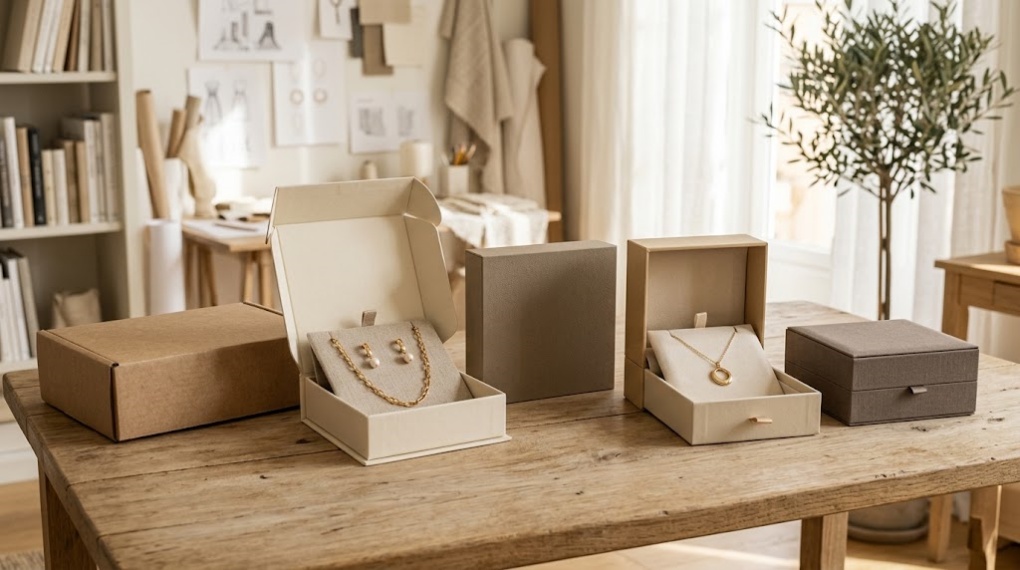
Légende recommandée pour l'image :
Différentes formules d'abonnement pour différents produits, budgets et expériences client.
Les coffrets à tiroirs constituent une autre option pour les produits d'abonnement haut de gamme.
La structure crée une séquence d'ouverture naturelle : le client tire le plateau intérieur vers l'extérieur et découvre le produit. Ce petit geste contribue à rendre l'expérience de déballage plus agréable.
Pour les bijoux, les boîtes à tiroirs peuvent également offrir suffisamment d'espace pour un encart, une carte d'entretien, une carte de remerciement ou d'autres supports de communication de la marque.
L'inconvénient est que les boîtes à tiroirs peuvent nécessiter plus de matériaux et d'assemblage que des emballages plus simples. Pour une entreprise d'abonnement expédiant des milliers de boîtes chaque mois, ces différences peuvent avoir un impact sur le coût total des emballages.
C’est pourquoi la structure des boîtes doit être évaluée en fonction du volume total des commandes plutôt qu’en fonction du seul prix unitaire.
Une boîte dont le prix unitaire est légèrement supérieur peut tout de même s'avérer intéressante si elle améliore la fidélisation de la clientèle, réduit les dommages causés aux produits ou renforce la notoriété de la marque.
Les boîtes à fermeture magnétique sont souvent associées aux emballages de luxe car elles offrent une expérience d'ouverture nette et agréable.
Le couvercle se ferme parfaitement, et l'aimant dissimulé assure une fermeture en douceur sans nécessiter de quincaillerie complexe. La boîte peut également être personnalisée par marquage à chaud, gaufrage, papier texturé ou autres traitements de surface.
Pour les marques d'abonnement de bijoux positionnées sur le segment haut de gamme du marché, l'emballage magnétique peut être un choix judicieux.
Cependant, le luxe ne signifie pas nécessairement ajouter toutes les techniques de finition disponibles.
Un design sobre peut souvent paraître plus luxueux qu'une boîte ornée de multiples décorations. Un papier doux au toucher, un petit logo métallisé et un insert parfaitement ajusté peuvent suffire.
Ceci est particulièrement important lors du développement boîtes à bijoux de luxe pour les marques qui vendent à des clients en Europe et en Amérique du Nord, où un emballage sobre et discret est souvent préféré à une décoration excessive.
Les clients abonnés reçoivent la même marque de façon répétée, la constance est donc importante.
L'emballage n'a pas besoin d'être entièrement renouvelé chaque mois. En réalité, conserver une structure de base cohérente peut faciliter la reconnaissance de la marque.
Une marque peut utiliser la même structure de boîte tout en modifiant la carte intérieure, le manchon en papier saisonnier ou un petit message imprimé.
Pour les collections limitées ou les niveaux d'adhésion spéciaux, boîtes à bijoux personnalisées peuvent également être réalisées avec différentes couleurs, inserts ou finitions.
Cela permet aux marques de créer des variations sans avoir à repenser l'ensemble du système d'emballage.
Pour les acheteurs B2B, cette approche est également plus facile à gérer du point de vue de la production. Une fois la structure de base de la boîte approuvée, les commandes ultérieures peuvent souvent utiliser les mêmes spécifications tout en ajustant certains éléments de design.
L'une des erreurs les plus fréquentes dans la conception d'emballages de bijoux haut de gamme est de trop se concentrer sur l'extérieur de la boîte.
Un joli couvercle ne peut compenser un intérieur mal conçu.
Les bijoux doivent rester en place pendant le transport. Les colliers ne doivent pas s'emmêler, les boucles d'oreilles doivent être bien maintenues et les bagues doivent être munies d'un système d'insertion empêchant tout mouvement inutile.
L'intérieur peut également comprendre des compartiments pour différentes pièces.
Par exemple, une box par abonnement contenant un collier et des boucles d'oreilles peut utiliser un insert moulé ou emballé avec des emplacements séparés pour chaque article. Un ensemble de bracelets peut nécessiter un compartiment plus long.
Lors de la commande boîtes d'emballage pour bijouxLes marques devraient donc, dans la mesure du possible, fournir les dimensions réelles du produit au fabricant d'emballages.
L'objectif n'est pas simplement de fabriquer un emballage adapté au produit. L'objectif est de faire en sorte que le produit soit bien présenté lorsque le client ouvre le colis.
La durabilité est un autre élément à prendre en compte pour les entreprises par abonnement.
Les modèles d'abonnement générant des déchets d'emballage récurrents, les clients sont susceptibles de prêter davantage attention aux matériaux utilisés par la marque.
Le carton, le carton recyclable, le papier certifié FSC, les encres à base d'eau ou de soja et les inserts sans plastique peuvent tous être envisagés en fonction des exigences du produit.
L'important est d'éviter de considérer le développement durable comme un simple argument marketing décoratif.
Un emballage plus léger, utilisant moins de matériaux, peut parfois s'avérer plus judicieux qu'un simple label de durabilité. Une structure recyclable et facile à trier pour le client peut également être plus pratique qu'un emballage complexe composé de plusieurs matériaux différents.
Pour les marques de bijoux, il est essentiel de concilier durabilité et protection. Un bel écrin recyclable, mais qui laisse les bijoux bouger pendant le transport, ne constitue pas une solution d'emballage idéale.
Avant de choisir une structure d'emballage, les marques doivent examiner l'ensemble du processus d'abonnement.
Posez quelques questions pratiques :
Quelle est la taille du bijou ?
Combien de pièces sont incluses dans chaque envoi ?
Le colis sera-t-il expédié directement au consommateur ?
L'emballage doit-il correspondre à un format d'enveloppe ou de carton d'expédition spécifique ?
Quel est le volume mensuel de commandes prévu ?
La boîte sera-t-elle réutilisée ?
La marque souhaite-t-elle une image luxueuse ou minimaliste ?
Quel budget d'emballage est réaliste compte tenu de la quantité prévue ?
Ces questions sont plus utiles que la simple recherche de la « plus belle box par abonnement ».
Pour une start-up lançant un nouveau service d'abonnement de bijoux, un simple coffret pliable personnalisé peut constituer un point de départ judicieux. Pour une marque de bijoux établie, s'adressant à une clientèle haut de gamme, un coffret magnétique rigide avec un insert personnalisé peut justifier l'investissement supplémentaire.
Le bon emballage est finalement celui qui correspond au modèle commercial.
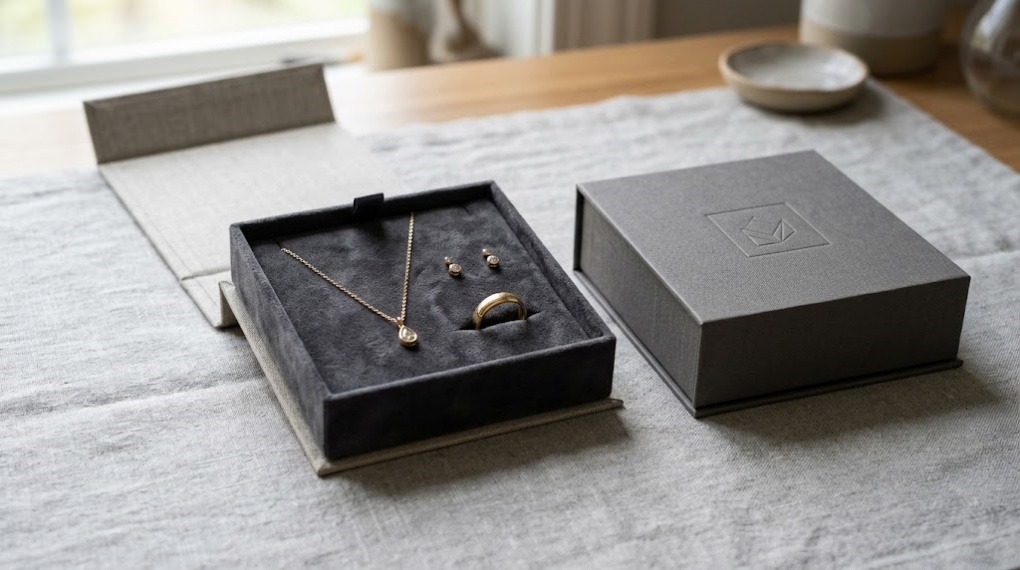
Légende recommandée pour l'image :
L'emballage personnalisé de bijoux combine structure, matériaux, inserts et finitions pour créer une expérience de marque cohérente.
Comment les marques de bijoux doivent-elles choisir un fabricant d'emballages ?
Pour une marque de bijoux par abonnement, trouver un fournisseur d'emballages ne se résume pas à trouver quelqu'un capable d'imprimer un logo.
Le fabricant devrait être en mesure de discuter des dimensions de la boîte, de l'épaisseur du carton, des options de papier, des encarts, de l'impression, de la finition, de l'assemblage et des quantités de production.
Il est également judicieux de vérifier si le fournisseur peut produire des échantillons avant la production en série. Un échantillon physique peut révéler des problèmes difficiles à identifier à partir d'un fichier de conception numérique, comme un couvercle trop serré, un insert qui ne maintient pas correctement le produit ou une couleur différente de celle du visuel approuvé.
Pour les entreprises qui commandent en grande quantité, la régularité de la production devient encore plus importante.
A fabricant de boîtes à bijoux sur mesure Il devrait être possible de maintenir des dimensions, une qualité d'impression, une finition et un assemblage constants lors de productions répétées.
Cela est particulièrement important pour les marques par abonnement, car les clients peuvent recevoir leur première box ce mois-ci et une autre plusieurs mois plus tard. Même si le design change, la qualité globale de l'emballage doit rester reconnaissable.
Alors, quelles sont les meilleures box par abonnement ?
Il n'y a pas de vainqueur universel.
Les boîtes d'expédition sont pratiques et économiques. Les étuis pliants sont souples et légers. Les boîtes rigides offrent une sensation de qualité supérieure. Les boîtes à tiroir procurent une expérience d'ouverture unique. Les boîtes magnétiques sont particulièrement adaptées aux produits de luxe. Pour les marques de bijoux par abonnement, la meilleure solution consiste souvent à combiner un emballage d'expédition protecteur et un coffret à bijoux intérieur élégant.
Plus important encore, l'emballage doit être conçu en fonction du produit plutôt que d'être choisi dans un catalogue standard.
Pour une marque de bijoux, l'écrin est le premier contact physique entre le client et le produit. Il doit protéger le bijou, mais aussi donner envie de l'ouvrir.
C’est là qu’une conception d’emballage bien pensée peut faire toute la différence.
Airetion Nous sommes spécialisés dans la fabrication de boîtes en carton sur mesure pour les acheteurs B2B du monde entier. Nous collaborons avec des marques qui ont besoin de boîtes à bijoux personnalisées, conçues en fonction de leurs produits, de leur identité visuelle et de leurs exigences de commande.
Des boîtes magnétiques rigides et des boîtes à tiroirs aux structures à couvercle et à base et aux inserts personnalisés, Airetion peut vous aider à développer des emballages depuis la structure initiale jusqu'à la production en série, en passant par l'échantillonnage.
Nous proposons la personnalisation de la taille de la boîte, du matériau du papier, de l'impression, du marquage à chaud, du gaufrage, des inserts intérieurs et d'autres options de finition.
Si votre marque de bijoux envisage une box par abonnement, le lancement d'une nouvelle collection ou la modernisation de ses emballages, envoyez-nous les dimensions de vos produits et vos exigences en matière d'emballage. Notre équipe vous aidera à concevoir une solution pratique et haut de gamme, sans superflu.
Airetion — Emballages personnalisés conçus pour votre marque.


droits d'auteur © 2026 XIAMEN AIRETION TECHNOLOGY CO. LTD.. Tous droits réservés .




 IPv6 network supported.